

Trailblazer Community goes read-only on 30 October. Give your Salesforce team a plan for the gap
From tomorrow, 30 October 2026, the Trailblazer Community forums stop taking new posts, and the replacement in Slack isn't due until November. Here's what I'd sort out today so your admins, developers and architects aren't stuck without a place to ask.
Tomorrow, 30 October 2026, the Trailblazer Community online forums become read-only. You'll still be able to search and read every old thread, but you won't be able to post a new question or reply. The new Trailblazer Community in Slack is due in November, with no exact date in the FAQ yet.
That leaves a gap. For most of us, the forums are where a stubborn Flow error or a failing Apex test finally gets solved, usually by someone we've never met. I don't think the move is a disaster. But I do think every Salesforce team should spend half an hour today deciding how it will work through the gap, and how it will use the new community once it opens.
What is actually changing
From Salesforce's FAQ, published on 7 October:
- 30 October 2026: the online forums become read-only. Existing content stays readable and searchable, and Salesforce says members don't need to do anything to save it.
- November 2026: the Trailblazer Community in Slack becomes generally available. All new discussions happen there.
- Early 2027: accepted answers from Slack product channels sync back to the Trailblazer Community website. Salesforce says they will be anonymized, summarized and search-indexed, so search engines, AI models and web visitors can find them.
A few practical details from the same FAQ matter more than they first appear:
- You sign in with your existing Trailblazer ID. You don't need a Slack licence or a new Slack account, and the community stays free.
- Salesforce recommends a personal email address on your Trailblazer ID, so your connections stay with you when you change jobs.
- If your employer blocks Slack, Salesforce's suggestion is to use a personal device, through the app or a web browser.
- Online (Chatter) groups don't move one-to-one into Slack channels. Local groups connect through regional hubs, such as
#hub-northern-california, and group leaders keep using trailblazercommunitygroups.com for members, meetings and recordings. Channels are public, and individual groups can't get private ones. - Slackbot will act as a community guide, and an Answers Agent will give AI responses drawn from what Salesforce calls trusted community knowledge.
The gap is the part to plan for
Christine Marshall put it plainly in her Salesforce Ben piece: once the forums close, you have to wait for the Slack launch before you can ask a new question in the community. If you've been putting off posting a question, today is the day.
There's a second, smaller gap that I'd watch as an architect. The forums are indexed on the open web, so the answer someone posted in 2019 still turns up when you search an error message. Slack conversations live inside a workspace. The plan to sync accepted answers back to the web starts in early 2027, and only for product channels. As Marshall points out, the FAQ doesn't say whether answers given between November and that rollout will be added later, and the public version will be a summary, not the full back-and-forth.
That back-and-forth is often where someone explains why a fix works, and when it doesn't.
What this means for a working Salesforce team
Most teams I've worked with have never written down how they get outside help. Someone searches, finds a thread, and the fix lands in a ticket with a forum link. That habit is about to change, so I'd make it explicit.
Your internal notes need the "why", not just a link. The old threads stay readable. But from November, the answer your developer gets may sit in a Slack thread you can't easily link from a Jira ticket, and the public copy may be a short summary. When a community answer fixes something in your org, copy the reasoning into your own runbook or knowledge base.
Check the Slack question with IT now, not in November. Many companies restrict which external Slack workspaces staff can join, or block Slack completely. Salesforce's answer is a personal device. That works for an individual, but it's a policy question for a team. If your admins can't reach the community from their work laptop, decide whether that's acceptable, or ask IT for an exception before launch.
Treat the Answers Agent like any other AI answer. A fast answer to a common configuration question is useful. But an answer that sounds confident is not the same as an answer tested in your org. My rule for the team is the same one I use for any AI suggestion: try it in a sandbox first, and check it against the official docs before it goes near production.
Group leaders have their own to-do list. Tom Bassett's notice to the London Architect Group is a good model. He moved group chats and Q&A to the chapter page from 19 October, asked members to join the chapter officially, and suggested downloading any files from the Chatter group they want to keep before 30 October. If you run or rely on a group, check whether it has done the same.
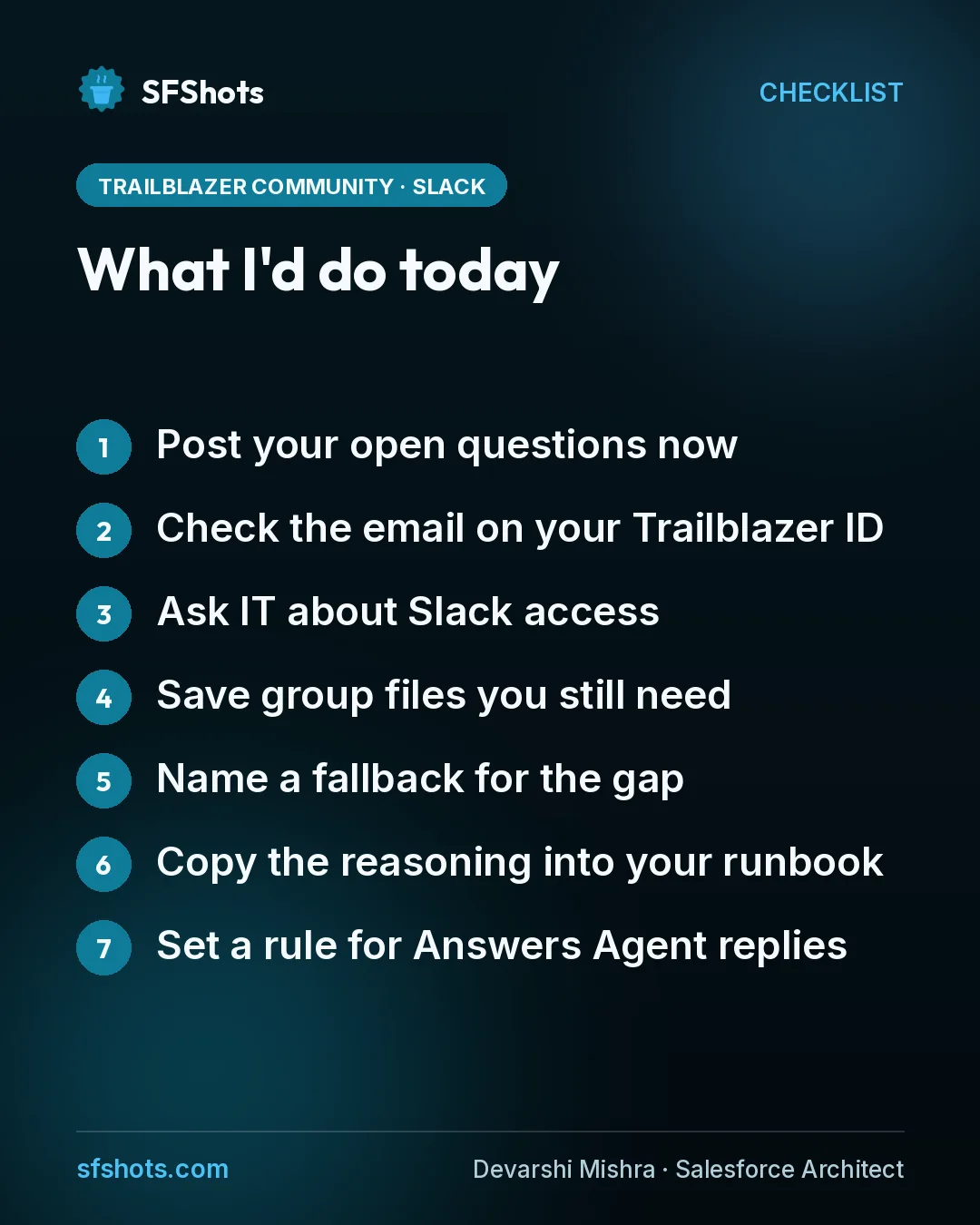
What I'd do today
- Post your open questions now. If you have a half-answered thread, add the final resolution before it freezes.
- Check the email on your Trailblazer ID. Move it to a personal address if your career history lives there.
- Ask IT about Slack access. Find out if external workspaces are allowed on work devices, and agree the rule for the team.
- Save group files you still need. If you rely on a Chatter group, download what you want to keep and join its chapter page.
- Name a fallback for the gap. Until the Slack launch, point the team to Salesforce Help, the official docs and a support case for blockers.
- Copy the reasoning into your runbook. When an outside answer fixes your org, record why it worked, not just the link.
- Set a rule for Answers Agent replies. Test in a sandbox and check the docs before anything reaches production.
The takeaway
For CRM and RevOps teams, the community is part of your support model, even if no contract says so. It's where your admins learn, where hard bugs get unstuck, and where your next hire probably built their skills. The move to Slack may well make answers faster. But for the next few weeks there's no place to post, and after that the knowledge will live somewhere new, partly behind an AI agent. Spend thirty minutes today on the checklist above, and your team won't notice the gap.
Sources
- Salesforce Help: Trailblazer Community Moving to Slack: Timeline, Access, and FAQs (published 7 Oct 2026)
- Salesforce Blog: The Online Trailblazer Community: Reimagined Together and Coming Soon to Slack (15 Sep 2026)
- Salesforce Ben: Will 20 Years of Trailblazer Community Knowledge Survive the Move to Slack? (19 Oct 2026)
- Trailblazer Community, Architect Group London: read-only notice from Forum Ambassador Tom Bassett (8 Oct 2026)