

ServiceNow says CRM switches now take 30 to 60 days. Map what leaving Salesforce would really take
On ServiceNow's Q3 2026 earnings call, Bill McDermott said its Sweep acquisition cuts CRM switches from years to "30 days, 60 days" for large companies. I can't test that claim, but I can tell you what any honest estimate depends on. Here's the switching-cost map I'd build for a Salesforce org this month, whether you plan to move or not.
On ServiceNow's third-quarter earnings call on 28 October, CEO Bill McDermott made a claim that every Salesforce team will hear again in a sales meeting soon. Talking about the company's acquisition of Sweep, he said one reason customers find it hard to change CRM is the long implementation cycle. "Instead of talking years, we're talking a month," he said. "We're talking like days, 30 days, 60 days for a serious company of serious scale."
Ctech picked the quote up on 1 November, and it's been doing the rounds since. I work on Salesforce integrations for a living, so my first reaction was a question: 30 days to move what, exactly?
What ServiceNow actually said
Here's what's on the record from the call transcript:
- The Sweep claim. McDermott said the Sweep "tuck-in" lets ServiceNow accelerate CRM deployment times from years to "30 days, 60 days".
- The CRM numbers. CFO Gina Mastantuono said CRM AI net new ACV tripled both quarter over quarter and year over year, and that CRM and industry workflows were in 13 of the quarter's top 20 deals.
- The intent. McDermott said "the old CRM was built for sales teams. The new one has to work across your entire business," and that customers are choosing to "rip and replace not just add alongside."
- The help. ServiceNow is bundling its own delivery experts into select large deals, and COO Amit Zavery said it is "using AI implementation agents" so that much of the heavy lifting is done by AI.
Some background. ServiceNow completed the Sweep acquisition on 1 September, according to Salesforce Ben, and neither side disclosed the price. Sweep builds an agentic layer that works across Salesforce, HubSpot and ServiceNow. CRN describes its tools as metadata agents, AI documentation and Q&A over your org's configuration, and an MCP interface. CRN also reports that ServiceNow runs a program called Now Next CRM to move customers from legacy CRM products, though it didn't name which ones.
Why I'm not dismissing it, and why I'm not believing it yet
I'll be fair. Tools that read an org's metadata and explain what it does are genuinely useful. A big part of any migration is archaeology: working out what a Flow from 2019 does, which integration writes to which field, and why a validation rule exists. If AI makes that part faster, migrations get shorter. That's true whichever CRM you move to.
But I didn't see a named example on the call of a full CRM migration at that speed, and an earnings call isn't a project plan. In my experience the timeline is set by the things a metadata scan can't decide for you:
- Integrations. Every system that reads from or writes to Salesforce needs rebuilding, retesting and a cutover plan. Your ERP team, your marketing platform and your data warehouse all have their own release calendars.
- Data history. Moving current records is one thing. Moving years of activities, files, field history and audit data, with ownership intact, is another.
- The rules nobody wrote down. Some of your process lives in automation. Some lives in a sales ops manager's head. A scan only finds the first kind.
- People. Reps, service agents and managers need to trust their new pipeline views and reports before you can switch off the old ones.
So I'd treat "30 days" as a claim to test against your own org, not a number to plan around.
The decision: know your own switching cost
Here's the practical part. You don't need to be thinking about leaving Salesforce for this to matter. Sooner or later, someone in your company, your CFO, a new CIO or a vendor, will ask "how hard would it be to move?" If the only answer is a guess, the vendor's number wins by default.
A switching-cost map is also just good hygiene. It's the same inventory you need for a clean Agentforce rollout, an org merge or a security review. I'd build it whether you stay or go.
Here's what I'd put in it:
Integrations first. List every connected app, integration user and named credential. For each one, note the system on the other end, its owner and whether it writes data back.
Automation you actually use. Count Flows, Apex triggers and validation rules, then mark which ones are still active and which ones fire on records people care about. Unused automation inflates every estimate.
Reports people open. Find the reports and dashboards that are actually used. A migration only has to rebuild those, and leadership will judge the new system by them.
The unwritten rules. Ask each team lead what they check by hand. Those steps are where a fast migration breaks.
Data you must keep. Note record volumes, field history, files and anything you're legally required to retain, and for how long.
The contract. Put renewal dates, notice periods and licence counts in one place, so a timeline conversation starts from facts.
What I'd do this month
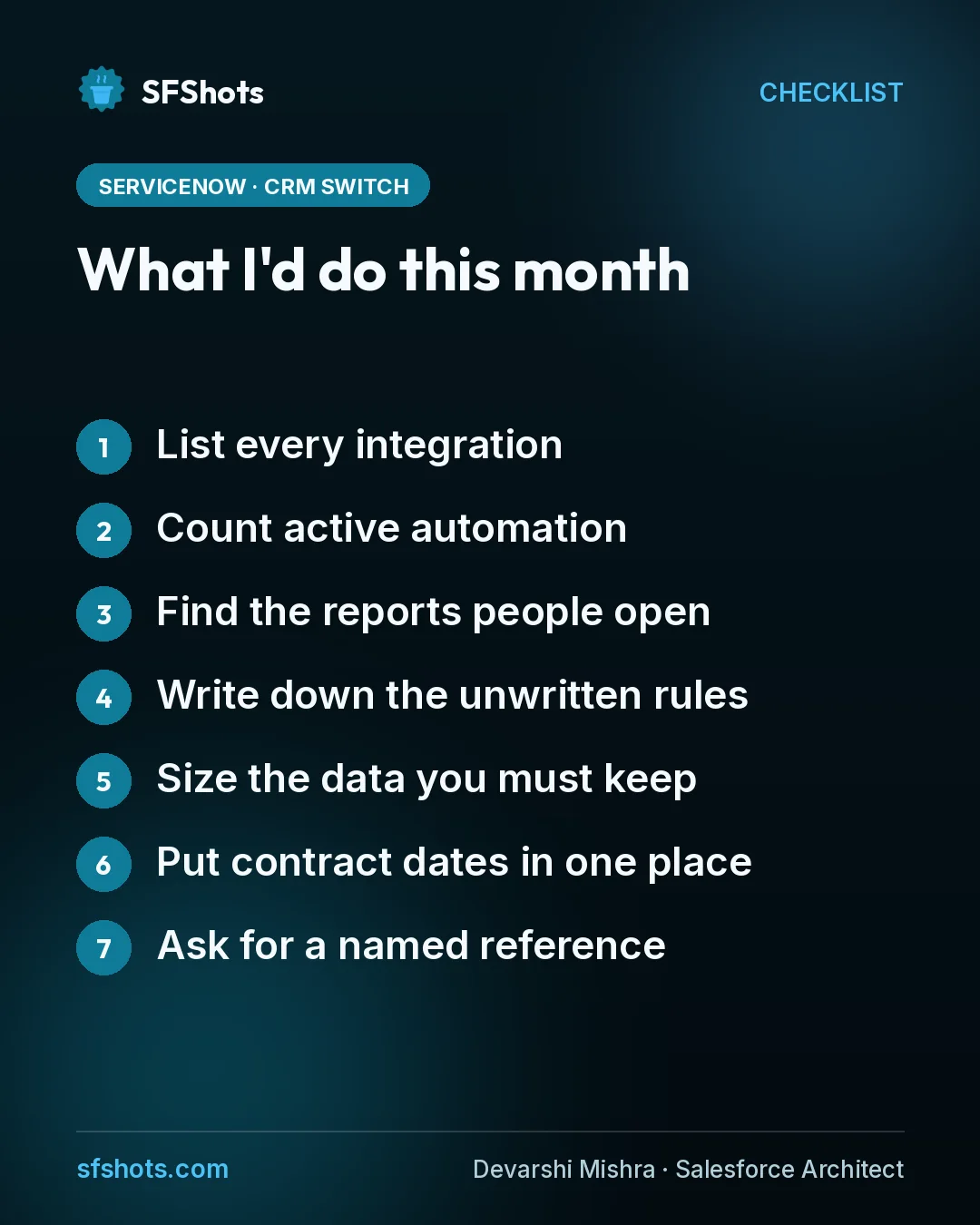
- List every integration. Note the system, owner and whether it writes back.
- Count active automation. Mark which Flows and triggers still matter.
- Find the reports people open. Rebuild only those in any plan.
- Write down the unwritten rules. Ask each team lead what they check by hand.
- Size the data you must keep. Include history, files and retention rules.
- Put contract dates in one place. Renewal, notice period and licence counts.
- Ask for a named reference. Any vendor quoting 30 days should show a migration your size.
The takeaway
For CRM and RevOps teams, the CRM market just got louder. ServiceNow is openly going after Salesforce customers, and it's using AI to argue that switching is no longer the multi-year project it used to be. Maybe for some orgs it won't be. But the only way to judge that claim, or any vendor's claim, is to know what your own org depends on. Build the switching-cost map now. It costs a few days, it makes your next renewal conversation better informed, and it makes your Salesforce org easier to run either way.
Sources
- The Motley Fool: ServiceNow (NOW) Q3 2026 Earnings Call Transcript (28 Oct 2026)
- Ctech: ServiceNow CEO says acquired Israeli startup Sweep helps it switch CRM customers in weeks (1 Nov 2026)
- CRN: ServiceNow Sharpens Its Salesforce Attack With Sweep Acquisition
- Salesforce Ben: ServiceNow Acquires Sweep in 'Deal Worth Hundreds of Millions' (4 Sep 2026)